Billion-crown apartment buildings to fundamentally change the Krkonoše town of Velká Úpa
Just last year, a Prague-based investor wanted to build four apartment buildings in Velká Úpa - now the plan calls for seven.
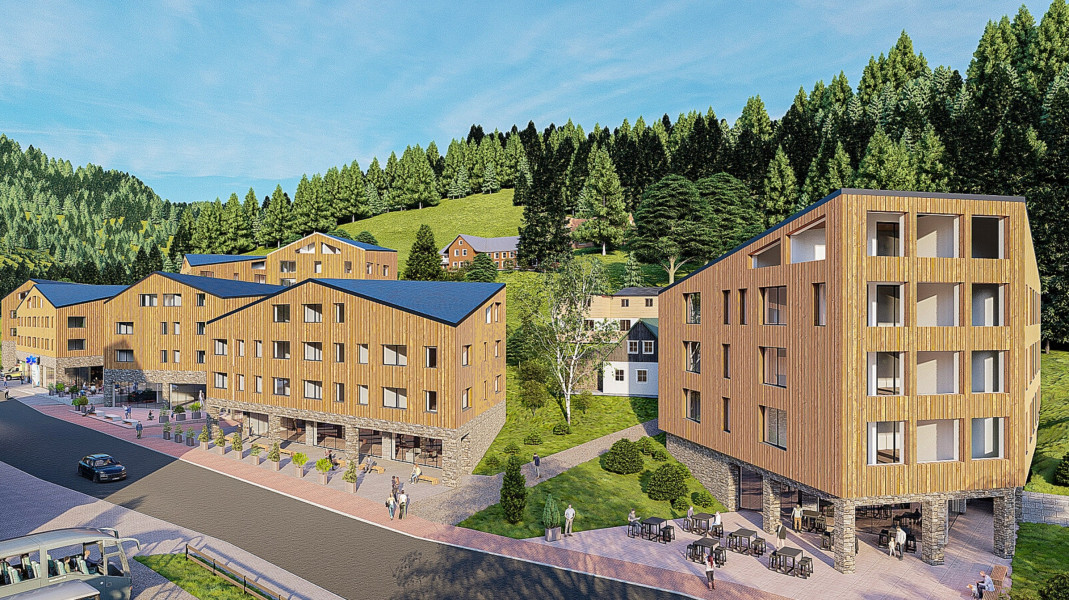
Just last year, a Prague-based investor wanted to build four apartment buildings in Velká Úpa – now the plan calls for seven. In total, 110 apartments and non-residential space for doctors' offices, shops, or restaurants are planned. The billion-crown project by the investment fund Aequitas Capital Investment will fundamentally change the center of Velká Úpa.
A year ago the Prague investor was counting on „only“ four buildings. Structures such as the former Hotel Hela or the Úpa pub will make way for the new development. Demolition of some buildings is due to start as early as this winter.
The investment fund Aequitas Capital Investment, backed by Prague lawyer Jan Langmeier, is currently one of the most active investors in the Krkonoše mountains. Next spring it plans to complete an apartment building with 29 units in Herlíkovice near Vrchlabí, on the site of the former Penzion Mlýn guesthouse.
Rezidence Pod Portáškami, as the investor named the project, represents an entirely different scale, however. Total costs are expected to reach around one billion crowns.
The buildings will not be as tall The project envisages seven variously sized buildings along the main road in Velká Úpa, where there is a ski slope with a cable car but shops and services are completely lacking. The investor has bought several buildings, including Hotel Hela and the former Úpa pub, and demolition was originally supposed to start this spring. In recent months, however, the project has undergone several changes. The winning design was created by the ABM architekti studio.
„Compared to the original study, this design is much more accommodating to the surrounding houses, mainly due to its lower height and better spatial placement with regard to the landscape and existing development,“ says fund founder Jan Langmeier.
Just last year, the investor's representative Jiří Lívanec sent a letter to the regulatory commission in Pec pod Sněžkou referring to four buildings: „The intention of the project is to build four accommodation buildings which, in addition to accommodation services, will offer services in their ground-floor sections facing the road.“
This June, however, the regulatory commission discussed and approved an architectural design already envisaging seven buildings. In the minutes of the meeting, the commission stated that it considers the set of buildings suitable for this location.
An apartment on our land Locals learn about the largest investment project in Velká Úpa's modern history only indirectly. „Demolition was supposed to start in spring, but nothing is happening. Nobody has spoken to us, it's completely dead,“ says Eva Beranová, who has lived in the house next to the dilapidated pub for almost 60 years.
The investor, however, denies failing to communicate with the residents affected by the project. „We have communicated, and continue to communicate, with a number of local residents and owners of the surrounding houses,“ says Jan Langmeier. The visualization published on the investor's website as well as that of Pec pod Sněžkou startled Jiří Hintner, who lives with his family in a house behind the former Hotel Hela. According to him, one of the planned buildings is drawn on their land.
„If you look at the land registry, there's an apartment building drawn on our property. What can you say to that? It feels like we don't exist at all. It's insane,“ he says, shaking his head. Conversely, the house he lives in is missing from the visualization.
„If you look at an aerial or hiking map showing how the houses and greenery in Velká Úpa are actually laid out, nothing in the visualization matches,“ Jiří Hintner notes.
We don't want to build on a greenfield site Jan Langmeier, however, maintains that construction will take place only on land owned by his fund: „Construction will largely take place on the footprint of the original old buildings. It is utterly absurd to suggest that we might want to build on someone else's land, and this is certainly not a greenfield development. That wouldn't even match our philosophy, which is that we want to, and do, buy up buildings that mostly no longer serve their original purpose, and build new buildings on their footprint.“
The designer is currently finishing the study, after which a combined zoning and building permit procedure will follow. Aequitas Capital Investment owns four buildings along the main road toward Pec, all of which will be demolished.
A year ago the Prague investor was counting on „only“ four buildings. Structures such as the former Hotel Hela or the Úpa pub will make way for the new development. Demolition of some buildings is due to start as early as this winter.
The investment fund Aequitas Capital Investment, backed by Prague lawyer Jan Langmeier, is currently one of the most active investors in the Krkonoše mountains. Next spring it plans to complete an apartment building with 29 units in Herlíkovice near Vrchlabí, on the site of the former Penzion Mlýn guesthouse.
Rezidence Pod Portáškami, as the investor named the project, represents an entirely different scale, however. Total costs are expected to reach around one billion crowns.
The buildings will not be as tall The project envisages seven variously sized buildings along the main road in Velká Úpa, where there is a ski slope with a cable car but shops and services are completely lacking. The investor has bought several buildings, including Hotel Hela and the former Úpa pub, and demolition was originally supposed to start this spring. In recent months, however, the project has undergone several changes. The winning design was created by the ABM architekti studio.
„Compared to the original study, this design is much more accommodating to the surrounding houses, mainly due to its lower height and better spatial placement with regard to the landscape and existing development,“ says fund founder Jan Langmeier.
Just last year, the investor's representative Jiří Lívanec sent a letter to the regulatory commission in Pec pod Sněžkou referring to four buildings: „The intention of the project is to build four accommodation buildings which, in addition to accommodation services, will offer services in their ground-floor sections facing the road.“
This June, however, the regulatory commission discussed and approved an architectural design already envisaging seven buildings. In the minutes of the meeting, the commission stated that it considers the set of buildings suitable for this location.
Apartment on our land Locals learn about the largest investment project in Velká Úpa's modern history only indirectly. „Demolition was supposed to start in spring, but nothing is happening. Nobody has spoken to us, it's completely dead,“ says Eva Beranová, who has lived in the house next to the dilapidated pub for almost 60 years.
The investor, however, denies failing to communicate with the residents affected by the project. „We have communicated, and continue to communicate, with a number of local residents and owners of the surrounding houses,“ says Jan Langmeier.
The visualization published on the investor's website as well as that of Pec pod Sněžkou startled Jiří Hintner, who lives with his family in a house behind the former Hotel Hela. According to him, one of the planned buildings is drawn on their land.
„If you look at the land registry, there's an apartment building drawn on our property. What can you say to that? It feels like we don't exist at all. It's insane,“ he says, shaking his head. Conversely, the house he lives in is missing from the visualization.
„If you look at an aerial or hiking map showing how the houses and greenery in Velká Úpa are actually laid out, nothing in the visualization matches,“ Jiří Hintner notes.
We don't want to build on a greenfield site Jan Langmeier, however, maintains that construction will take place only on land owned by his fund: „Construction will largely take place on the footprint of the original old buildings. It is utterly absurd to suggest that we might want to build on someone else's land, and this is certainly not a greenfield development. That wouldn't even match our philosophy, which is that we want to, and do, buy up buildings that mostly no longer serve their original purpose, and build new buildings on their footprint.“
The designer is currently finishing the study, after which a combined zoning and building permit procedure will follow. Aequitas Capital Investment owns four buildings along the main road toward Pec, all of which will be demolished.
„We own a total of four buildings, specifically two former hotels and two other buildings. All of them are slated for demolition, because their condition does not allow renovation and their location would not fit the concept of being accommodating toward the surrounding development and landscape,“ Langmeier notes. He says demolition of the first buildings will begin this winter.
The developer plans to start construction of the first apartments in spring or summer of next year. The apartment complex in Velká Úpa should be completed within three years. „We expect construction work to take two to two and a half years,“ Jan Langmeier confirms.
He does not expect the energy crisis and economic slowdown to hold back the project. He considers Velká Úpa such an attractive location that even if overall interest in investment apartments were to decline on the Czech market, Rezidence Pod Portáškami would not be affected: „The target group for our project consists overwhelmingly of people who will buy apartments with their own capital. They will therefore not be affected by rising mortgage interest rates.“
A square and a new cable car The dilapidated Hotel Uran has already disappeared from the center of Velká Úpa. The town bought it last year for 20 million crowns and had it demolished. A square is to be built on the site. According to the Pec town hall, it is important that the new apartment buildings also include facilities for services, which are desperately lacking in Velká Úpa.
„It's essential that buildings shaping public space also contain non-residential space. Otherwise Velká Úpa won't come to life,“ Pec's mayor at the time, Alan Tomášek (independent), said previously. Another investment is planned by SkiResort Černá hora-Pec, which operates several facilities in the eastern Krkonoše, including the cable car and ski slopes in Velká Úpa. It is preparing to replace the existing three-seat cable car to Portášky with a faster and more comfortable detachable four-seat lift.
Next year the operator hopes to obtain a permit, with construction of the cable car planned for 2024.
„For us, this is one of the main priorities. If we reach agreement with the landowners and the approval process runs smoothly, I see no reason for a major delay. The existing cable car is old and it's getting harder and harder to keep it running,“ Richard Kirnig, owner of Mega Plus, the company that owns the largest ski resort in the Krkonoše, said in a recent interview published on the Pec pod Sněžkou website.
The company has also not abandoned the vision of a cable car connection between Velká Úpa and Pec. „We still assume there is potential to connect the two areas, where the starting point, for example for day visitors, would be the area in Velká Úpa, from which cable cars would link Úpa with Pec,“ Kirnig says, making no secret of his optimism.
Author: Tomáš Plecháč